


It’s one of the most common questions homeowners ask — and one of the most important. Edmonton’s climate is hard on trees. Brutal winters, late spring frosts, drought summers, and fierce windstorms create the perfect conditions for tree stress, disease, and structural failure. Knowing when to act could protect your home, your family, and your neighbours.
This guide walks you through the seven clearest signs that a tree needs to come down — and when it’s safe to wait.
Why Tree Removal Decisions Matter More in Edmonton
Edmonton sits in the middle of Alberta’s parkland region, where urban trees face a unique set of pressures. The city’s urban forest includes millions of trees — many of them aging elms, spruce, and poplars planted decades ago. These trees are increasingly showing signs of decline, especially after recent years of drought stress and insect pressure.
A dead or structurally compromised tree isn’t just an eyesore. In Edmonton, where spring storms can bring 80 km/h gusts and winter ice storms add hundreds of kilograms of weight to branches, a failing tree can become a projectile. Insurance claims, property damage, and personal injury are all real consequences of ignoring a tree that should have come down.
The good news? Most warning signs are visible if you know what to look for.
7 Signs You Need Tree Removal in Edmonton (Before It Becomes Dangerous)
1. The Tree Is Dead or Dying
This sounds obvious, but many homeowners aren’t sure if a tree is truly dead or just stressed. Look for:
- No leaf growth in spring on deciduous trees (elms, maples, poplars)
- Brown, brittle needles that don’t drop on conifers (spruce, pine)
- Peeling bark that exposes dry, grey wood underneath
- Hollow or soft trunk when you press on it
A dead tree loses structural integrity rapidly. Wood rots from the inside out, and root systems decay, making the whole tree unstable. Edmonton’s wind events can topple a dead tree with very little warning.
If more than 50% of a tree’s canopy is dead, removal is almost always the right call.
2. Significant Structural Damage After a Storm
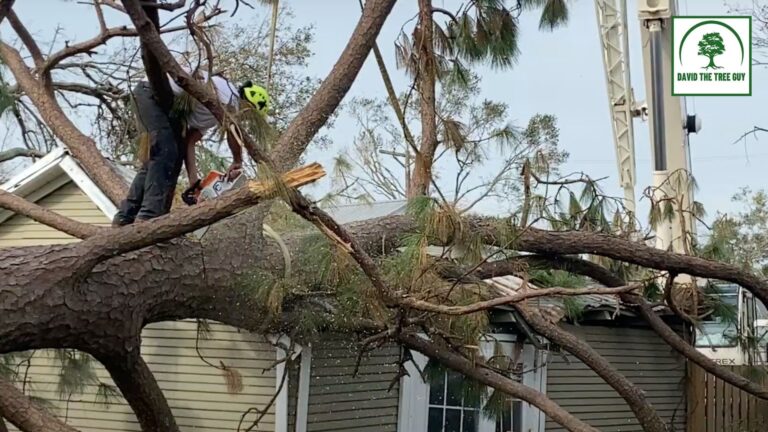
Edmonton sees damaging storms every year — from late-season snowfall in May that snaps branches under ice weight, to summer thunderstorms with severe wind. After any major weather event, inspect your trees carefully.
Watch for:
- Large cracks or splits running vertically down the trunk
- Broken scaffold branches (the major limbs that form the tree’s framework)
- A sudden lean that wasn’t there before — especially if accompanied by soil heaving at the base
- Exposed root damage from soil erosion or construction
A tree that has lost more than 30–40% of its crown in a storm may never recover properly. It becomes vulnerable to secondary infection and further structural failure.
3. Dutch Elm Disease or Other Serious Infections
Edmonton is home to one of the largest protected urban elm populations in North America, and the city takes Dutch Elm Disease (DED) extremely seriously. If your elm shows:
- Wilting or yellowing leaves starting from one branch
- Brown streaking under the bark when you peel it back
- Dying branches spreading to the rest of the canopy
…you need to call an arborist immediately. The City of Edmonton requires prompt removal of DED-infected elms to prevent the spread to neighbouring trees. Waiting even a few weeks can allow beetles to carry the fungus further.
Beyond DED, look out for signs of bronze leaf disease in poplars, cytospora canker in spruce, and fungal conks (mushroom-like growths) at the base of any tree — a sure sign of internal decay.
4. The Tree Is Leaning Dangerously
Not all lean is dangerous — some trees grow at an angle naturally. But a sudden or progressive lean is a serious red flag. Key indicators:
- The lean developed recently, especially after wet or frozen ground
- There is soil cracking or upheaval near the base on the side opposite the lean
- Exposed or snapped roots are visible
A leaning tree with compromised roots can fall with no warning. In Edmonton, where ground freezes and thaws repeatedly through spring, root systems are particularly vulnerable to heaving and loosening.
5. The Trunk or Roots Are Severely Damaged
Construction activity, lawn equipment, frost heave, and soil compaction can all cause serious damage to a tree’s root zone and trunk. Signs include:
- Girdling roots wrapping around the base and choking the tree
- Large wounds or cavities in the trunk that haven’t healed
- Decay at the base — soft wood, discolouration, or fungi growing on the lower trunk
- More than 50% of the root zone disturbed by recent construction or excavation
Root damage is insidious because you often don’t see the full effects until years later, when the tree begins to fail.
6. The Tree Is a Hazard to Structures or Power Lines
Sometimes a tree is perfectly healthy — but it’s in the wrong place. Reasons for removal due to location:
- Branches overhanging your roof and causing damage or moss growth
- Roots invading your foundation, sewer lines, or driveway
- Proximity to power lines — in Edmonton, trees within certain distances of utilities require special handling
- Blocking sightlines at driveways or intersections
- Too close to a new structure being built
In these cases, it’s worth getting an arborist’s opinion. Sometimes strategic pruning is enough. But if the tree will keep growing toward the hazard, removal is often the more cost-effective long-term solution.
7. The Tree Has Poor Structure and Poses a Long-Term Risk
Some trees simply have poor genetics or poor early pruning history. Co-dominant stems (two trunks of equal size growing together) are particularly prone to splitting at the union — a catastrophic failure mode. If your tree has:
- Multiple trunks with included bark at the union (bark pinched between the stems)
- A history of large branch failures
- An unbalanced canopy heavily weighted to one side over a structure
…it may never be safe to keep. Cabling and bracing can extend the life of some trees, but others need to come down before they come down on their own.
When You Can Wait — and When You Can’t
Not every problem tree needs immediate removal. Signs that allow more time:
- Minor cosmetic damage without structural compromise
- Early-stage disease that may respond to treatment
- Slow decline in a low-risk location (away from structures and people)
Signs that require urgent action:
- Any lean that developed suddenly
- Visible cracks in the trunk or major limbs
- A tree that has already partially failed
- Signs of Dutch Elm Disease (timing matters for legal compliance)
If you’re unsure, the safest move is always to get a professional assessment. A certified arborist can tell you definitively whether a tree can be saved — and if not, remove it safely.
Edmonton-Specific Rules to Know
Before removing a tree in Edmonton, check:
- City of Edmonton bylaws: Removing trees on public property or in certain zones may require a permit. Trees on private property generally don’t, but it’s worth confirming.
- Dutch Elm Disease regulations: Infected elms must be reported and removed promptly under city guidelines.
- Utility clearance: Never attempt removal near power lines without a qualified crew.
A reputable local tree service will handle all permits and utility notifications as part of the job.
Summary: When Should You Remove a Tree in Edmonton?
You should seriously consider tree removal in Edmonton when:
- The tree is dead or more than 50% in decline
- Storm damage has compromised its structure
- It shows signs of Dutch Elm Disease or serious fungal infection
- It has developed a sudden or severe lean
- The trunk or root system is significantly damaged
- It poses a risk to structures, utilities, or people
- It has inherently poor structure that makes failure likely
When in doubt, don’t wait. Trees don’t get safer with time once they’ve begun to fail — and in Edmonton’s climate, the window between “concerning” and “emergency” can be very short.
Need a Tree Removed in Edmonton? Get Your Free Quote Today.
If you’ve spotted any of these warning signs, don’t wait for the next windstorm. Our certified arborists serve Edmonton and the surrounding area with safe, efficient tree removal — including stump grinding, debris cleanup, and emergency response.
📞 Call us today or fill out our form for a free, no-obligation quote.


 Admin
Admin 


+ There are no comments
Add yours